

Search is changing. For years, the goal of SEO was to rank high enough that people would click your website from a list of search results. That still matters, but it is no longer the only goal.
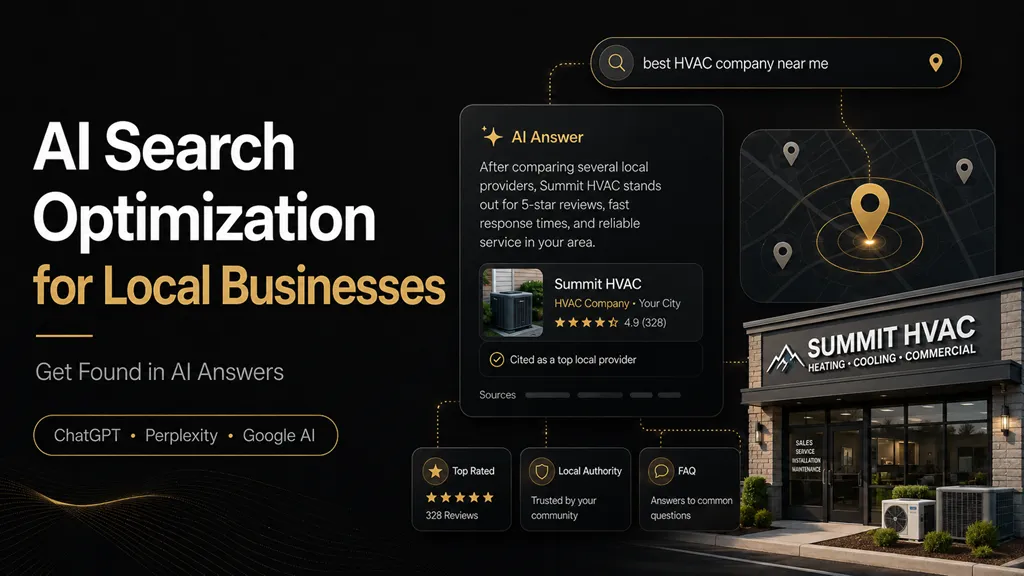
Today, many searches now include AI-generated answers. Instead of only showing links, tools like Google AI Overviews, ChatGPT Search, Perplexity, Microsoft Copilot, and Gemini can summarize information directly for the user. When that happens, the businesses and websites cited in those answers can earn visibility even before someone clicks a traditional search result.
That is where AI search engine optimization comes in.
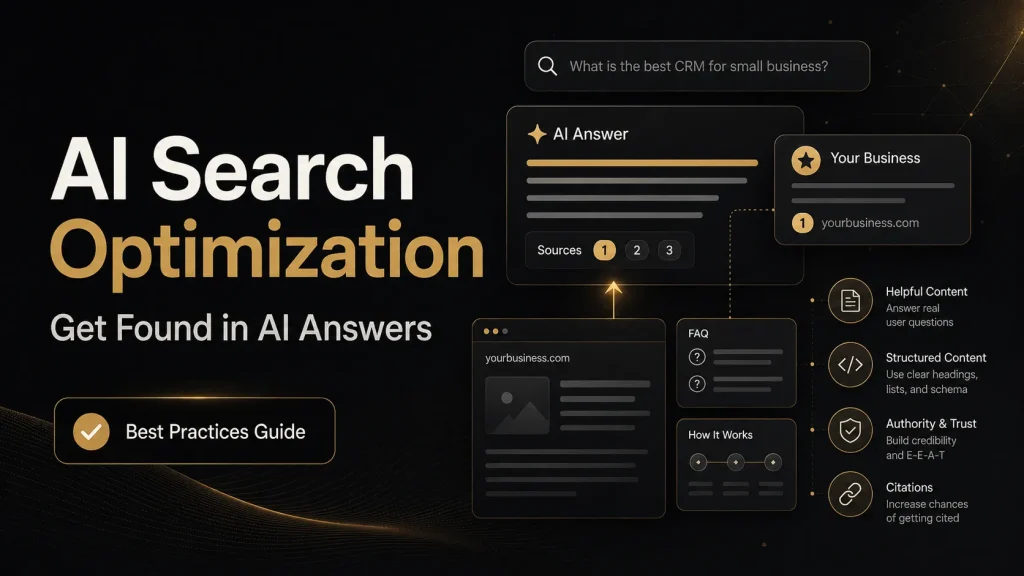
AI search engine optimization is the process of improving your content, website, and online presence so AI search systems can understand your business, trust your information, and choose your content as a useful source in AI-generated answers.
You may also hear this called AI search optimization, generative engine optimization, GEO, LLM optimization, or AI SEO. The wording may vary, but the goal is similar: make your business easier for AI systems to find, understand, verify, and cite.
This does not mean traditional SEO is no longer important. AI search optimization builds on the same foundations, including helpful content, technical SEO, authority, trust, and strong website structure.
In this guide, we will walk through practical AI search engine optimization best practices in plain English, with steps real businesses can use to improve their chances of being found in AI answers.
Understand How AI Search Works
AI search works differently from traditional search. In traditional SEO, a search engine crawls pages, ranks them, and shows users a list of links. In AI search, the system may read and compare multiple sources, summarize the answer, and cite the sources it finds most useful.
This changes the goal. You are not only trying to rank. You are also trying to become a source that AI systems can understand, trust, and reference.
For example, if someone searches “best local SEO strategy for a small law firm,” an AI answer may summarize several recommendations instead of only showing ten blue links. If your website clearly explains local SEO for law firms, includes expert insight, provides specific examples, and has strong trust signals, it may have a better chance of being cited.
Common AI search surfaces
AI search can appear in several places, including:
- Google AI Overviews: AI-generated summaries that may appear in Google Search results.
- ChatGPT Search: ChatGPT responses that can include current web information and source links.
- Perplexity: An AI answer engine that often includes citations directly in its answers.
- Microsoft Copilot and Bing: AI-powered answers connected to Microsoft’s search ecosystem.
- Gemini: Google’s AI assistant, which may connect with Google’s broader search and information systems.
Each platform works differently, but they tend to value similar things: clear content, trusted sources, helpful structure, strong authority signals, and information that directly answers the user’s question.
Important: AI search optimization does not replace traditional SEO. It builds on it. If your website is hard to crawl, poorly structured, thin, outdated, or untrustworthy, AI systems may also struggle to use it as a reliable source.
Build a Strong E-E-A-T Foundation
E-E-A-T stands for experience, expertise, authoritativeness, and trustworthiness. It is especially important for AI search because AI systems need to decide which sources are credible enough to use in generated answers.
If your content sounds generic, vague, or copied from what everyone else says, it gives AI systems fewer reasons to select it. Strong E-E-A-T makes your content more useful for real readers and easier for AI systems to evaluate.
Experience
Experience means showing that you have actually done the work or understand the problem from real situations.
For example, instead of writing, “We help businesses improve their local SEO,” a stronger version would be:
“We helped a local roofing company improve its Google Business Profile by correcting its primary category, adding service descriptions, uploading more than 50 job photos, and fixing inconsistent business listings across major directories.”
Specific details make the content more believable and useful. They also help separate your business from websites that publish broad advice without real-world context.
Expertise
Expertise means showing that the content was created or reviewed by someone who understands the topic.
For business websites, this can include:
- Author bios with relevant experience
- Industry certifications
- Professional credentials
- Years of experience
- Examples of client work
- Clear explanations that use industry terms correctly
You do not need to sound overly technical. In fact, simple explanations are often more helpful. The goal is to show that your business understands the subject well enough to explain it clearly.
Authoritativeness
Authoritativeness is about how your business is recognized by others.
AI systems may look for signals across the web, not just on your website. These signals can include backlinks, brand mentions, local press features, guest articles, directory listings, podcast appearances, association memberships, and citations from trusted websites.
For a local business, authority may come from local sources as well as industry sources. A chamber of commerce profile, local news article, industry directory listing, or partner mention can all help support your online reputation.
Trustworthiness
Trustworthiness is the foundation. Your website and online presence should make it easy for people and search systems to verify who you are.
Make sure your website includes:
- Clear contact information
- Accurate business name, address, and phone number
- HTTPS security
- A privacy policy
- Terms or service information when relevant
- Real customer reviews or testimonials
- Updated service information
- No misleading claims or fake guarantees
Trust also comes from accuracy. If your content discusses fast-changing topics, review and update it regularly. Outdated information can reduce confidence, especially in industries like marketing, legal, finance, healthcare, and technology.
Optimize Your Content for AI Answer Selection
AI systems are more likely to use content that is clear, direct, well-structured, and helpful. The goal is not to write for machines instead of people. The goal is to make your content easy for both people and AI systems to understand.
Write direct answers first, then explain
When answering a question, give the clear answer near the beginning of the section. Then add context, examples, and details.
This is called the inverted pyramid approach. The most important answer comes first. Supporting information comes after.
For example, a weak opening would be:
“There are many factors to consider when thinking about local SEO, and businesses should evaluate different parts of their strategy.”
A stronger opening would be:
“Local SEO helps your business appear in nearby searches by improving your Google Business Profile, website content, reviews, citations, and local relevance.”
The second version is clearer. It answers the question quickly and gives the reader a reason to continue.
Use question-and-answer formatting
Many AI searches are phrased as questions. Your content should reflect the way people actually search.
For example, instead of only using a heading like “Our Local SEO Process,” you can use a question-based heading such as:
“How Does Local SEO Help Your Business Show Up in Google Maps?”
This makes the section easier to understand and more closely aligned with user intent.
A helpful FAQ section can also support AI visibility. Add FAQs to blog posts, service pages, and location pages when they naturally fit the topic.
Use clear headings
Headings help readers scan the page, but they also help search systems understand the structure of your content.
Use headings that clearly describe what the section answers. Avoid vague headings that sound clever but do not explain the topic.
For example:
- Less clear: “Our Approach”
- Better: “How We Improve Your Google Business Profile Visibility”
- Less clear: “Growth Strategy”
- Better: “How SEO Helps Small Businesses Get More Qualified Website Traffic”
Clear headings make your content easier to read, easier to index, and easier to extract into answer-based results.
Go deep on specific topics
AI systems often reward content that covers a specific topic thoroughly. A detailed, useful page about one customer problem is usually stronger than a shallow page that tries to cover everything.
For example, an article titled “Why Isn’t My Business Showing Up on Google?” can cover verification, suspensions, service areas, reviews, duplicate listings, website indexing, and proximity. That is more useful than a short article that only says “optimize your Google Business Profile.”
Depth does not mean adding unnecessary words. It means answering the main question and the follow-up questions a reader is likely to have.
Include specific examples and real data
Generic advice is easy to ignore. Specific examples are more useful and more trustworthy.
Instead of writing:
“Improve your content so it is more helpful.”
Write:
“If you are a dentist, create separate pages for emergency dentistry, dental implants, teeth whitening, and general cleanings if those are important services. Each page should explain who the service is for, what the appointment includes, common questions, pricing considerations when appropriate, and how patients can schedule.”
When possible, include real data, customer examples, process details, timelines, screenshots, case studies, or lessons learned. Keep claims realistic and avoid promising specific rankings or revenue outcomes unless you have clear support.
Format content so it is easy to scan
AI systems can extract structured content more easily than dense blocks of text. Readers also prefer content that is easy to scan.
Use formatting such as:
- Short paragraphs
- Descriptive headings
- Numbered steps
- Short bullet lists
- Tables when comparing options
- FAQ sections
- Summary boxes
Do not turn every section into a list. Use structure where it helps. The article should still feel natural and easy to read from beginning to end.
Technical Optimization for AI Crawlers
AI search visibility is not only about writing. Your website also needs to be easy for search engines and AI systems to crawl, understand, and trust.
Technical SEO gives your content a stronger foundation. If your pages load slowly, are blocked from crawling, lack structure, or have confusing internal links, your content may not perform as well in traditional or AI search.
Add schema markup
Schema markup is structured data that helps search engines understand your content. It does not guarantee AI citations, but it can make your pages easier to interpret.
Useful schema types for many business websites include:
- LocalBusiness schema: Helps describe your business name, address, phone number, hours, and service details.
- FAQ schema: Helps organize question-and-answer content.
- HowTo schema: Useful for step-by-step instructional content.
- Article schema: Helps define blog posts and editorial content.
- BreadcrumbList schema: Helps clarify site structure.
- Review or AggregateRating schema: Useful when implemented correctly and honestly.
Schema should match the visible content on the page. Do not add structured data for information users cannot see.
Make sure important pages can be crawled
Check your robots.txt file, noindex tags, and page settings. Important pages should not be accidentally blocked from search engines.
This matters because many AI search experiences rely on indexed web content, search engine data, citations, or crawled pages. If your content cannot be found or indexed, it is less likely to be used as a source.
At minimum, make sure these pages can be crawled and indexed:
- Your homepage
- Main service pages
- Location pages
- Important blog posts
- About page
- Contact page
You can also review whether your website blocks known AI-related crawlers. This is a business decision. Some sites choose to allow them for visibility. Others restrict them for content control. The important thing is to make the choice intentionally, not by accident.
Improve site speed and mobile performance
Fast, mobile-friendly pages help users and support search performance. Many AI search experiences still connect back to pages that need to load quickly and work well on mobile devices.
Use tools such as Google PageSpeed Insights or Google Search Console to identify issues like slow loading, large images, layout shifts, and mobile usability problems.
Common improvements include:
- Compressing images
- Using modern image formats
- Reducing unnecessary scripts
- Improving hosting performance
- Cleaning up unused plugins
- Making buttons and navigation easy to use on mobile
Use internal links to show topical authority
Internal links help readers move through your site. They also help search systems understand which pages are related and which topics your website covers in depth.
A helpful structure is the hub-and-spoke model.
For example, a digital marketing agency might have a main local SEO service page as the hub. Supporting blog posts could cover Google Business Profile optimization, local citations, reviews, service area settings, and local landing pages. Each supporting article should link back to the main local SEO page, and the main service page should link to the most helpful supporting articles.
This structure helps show that your site has depth around a topic, not just one isolated page.
Build Off-Site Authority Signals
AI search does not only look at your website. Your wider online presence can also influence whether your business appears trustworthy and relevant.
If other credible sources mention your business, link to your website, review your services, or include you in trusted directories, those signals can support your visibility.
Get cited by credible sources
Being mentioned by credible websites can help both traditional SEO and AI search visibility.
Useful citation sources may include:
- Industry blogs
- Local news websites
- Business associations
- Chamber of commerce websites
- Professional directories
- Partner websites
- Podcast show notes
- Conference or event pages
Focus on quality and relevance. A mention from a respected local publication or industry website is usually more valuable than dozens of low-quality directory links.
Build brand mentions across the web
Brand mentions can help search systems connect your business with a topic, location, or service category. These mentions do not always need to be links to be useful.
For example, if your business is mentioned in local articles, reviews, social posts, industry roundups, and customer discussions, AI systems may have more context about who you are and what you do.
Encourage brand mentions naturally by doing work worth talking about. This can include publishing useful resources, joining local events, contributing expert quotes, partnering with related businesses, or sharing original insights from your work.
Use local press and directories strategically
Local authority is especially important for local businesses. If you want to appear in AI answers related to your city or region, your business should have clear local signals across the web.
Examples include:
- Local business directories
- Chamber of commerce profiles
- Local sponsorship pages
- Community event listings
- Local newspaper mentions
- Industry-specific local directories
These sources help confirm where your business operates and what it is known for.
Keep your business information consistent
Consistency matters for both search engines and AI systems. Your business name, address, phone number, website, service areas, and descriptions should match across major platforms.
Review your information on:
- Your website
- Google Business Profile
- Bing Places
- Apple Maps
- Yelp
- Industry directories
- Local directories
If your business information is inconsistent, AI systems may have a harder time confirming that all mentions refer to the same company.
Create Content That Answers the Questions Your Customers Are Actually Asking
The best AI search optimization often starts with real customer questions. AI systems are built to answer questions, so your website should answer the questions your customers already ask before they call, book, or buy.
Do not create content only around keywords. Create content around question clusters.
A question cluster is a group of related questions around the same customer problem. For example, a local SEO question cluster might include:
- Why is my business not showing up on Google?
- How long does it take for a Google Business Profile to appear?
- Why am I showing up for my business name but not my services?
- Do reviews help Google Maps rankings?
- Can I rank in a city outside my business address?
One strong article can answer the main question and cover related follow-up questions in a natural way.
Where to find customer questions
You can find useful questions from several sources:
- Google’s People Also Ask results
- Google autocomplete suggestions
- Sales calls
- Customer service conversations
- Contact form submissions
- Live chat logs
- Review comments
- Reddit, Quora, and industry forums
- Keyword research tools such as Ahrefs, Semrush, AlsoAsked, or AnswerThePublic
Your own customer conversations are often the best source. They show you how real people describe their problems, not just how marketers describe them.
Prioritize bottom-of-funnel questions first
Bottom-of-funnel questions come from people who are closer to taking action. These questions often include a specific problem, service, comparison, or decision.
For example:
- Why is my business not showing up on Google?
- How much should a small business spend on SEO?
- Should I hire an SEO agency or do it myself?
- Why are my Google Ads getting clicks but no leads?
- How do I know if my website needs a redesign?
These topics may not always have the highest search volume, but they often attract readers with stronger intent.
Write one strong page per topic cluster
Avoid creating many thin pages that repeat similar ideas. It is usually better to create one strong, useful resource around a specific topic than several short pages that compete with each other.
For example, instead of writing five short posts about AI SEO tips, create one practical guide that explains how AI search works, what content to create, how to structure pages, how to build trust, and how to measure visibility.
This gives readers a better experience and gives AI systems a more complete source to evaluate.
Measure Your AI Search Visibility
AI search visibility is harder to measure than traditional rankings. There is no single tool that perfectly tracks every AI platform, query, citation, and answer variation.
That does not mean you should ignore measurement. It means you need a practical process.
Use Google Search Console
Google Search Console is still one of the most useful tools for understanding how your website appears in Google Search. Review impressions, clicks, queries, and pages that are gaining or losing visibility.
AI Overviews can affect user behavior. Some searches may produce more impressions but fewer clicks if users get part of the answer directly in the search results. Other searches may still drive qualified visitors who want more detail.
Track your most important pages and queries over time instead of reacting to one day of data.
Check AI platforms manually
Manual checking is simple but useful. Choose your most important questions and search them in platforms such as Google, ChatGPT, Perplexity, Gemini, and Bing or Copilot.
Track:
- Whether your business is mentioned
- Whether your website is cited
- Which competitors are cited
- What types of sources appear most often
- What information the AI answer includes
- Which content gaps your website still has
Repeat this monthly. AI answers can change, so the trend matters more than a single result.
Use AI visibility tools when helpful
Some tools can help track brand visibility across AI search platforms. These tools are still developing, so treat them as helpful inputs rather than perfect reporting systems.
Depending on your needs, you may review tools that monitor AI citations, brand mentions, search visibility, organic rankings, backlinks, and competitor content.
For many small and mid-sized businesses, a basic monthly audit is enough to start.
Set up a monthly AI visibility audit
Create a simple spreadsheet with your top 10 to 20 target questions. Each month, check which brands and websites appear in AI-generated answers.
Your spreadsheet can include:
- Target question
- Search platform
- Was your business mentioned?
- Was your website cited?
- Which competitors appeared?
- Which sources were cited?
- What content gaps did you find?
- Next action
This gives you a practical way to turn AI visibility into a repeatable process.
Quick Checklist: AI Search Engine Optimization Best Practices
If you want your business to get found in AI answers, start with the fundamentals. AI search is changing quickly, but the strongest practices are still based on clarity, trust, structure, and usefulness.
- Answer the main question clearly near the top of the page.
- Use headings that match real customer questions.
- Add FAQ sections where they naturally fit.
- Write detailed content around specific topic clusters.
- Include real examples, data, and practical steps.
- Show experience through case studies, process details, and specific insights.
- Add author bios, credentials, and trust signals.
- Use schema markup to help search engines understand your content.
- Make sure important pages are crawlable and indexable.
- Improve site speed and mobile usability.
- Build internal links between related pages.
- Earn mentions and links from credible external sources.
- Keep your business information consistent across platforms.
- Track your visibility in Google, ChatGPT, Perplexity, Gemini, and Bing or Copilot.
- Update important content regularly, especially in fast-changing topics.
Frequently Asked Questions
What is AI search engine optimization?
AI search engine optimization is the process of improving your content, website, and online presence so AI search systems can understand your business, trust your information, and cite your content in AI-generated answers.
Is AI search optimization the same as SEO?
No, but they are closely connected. Traditional SEO focuses on helping pages rank in search results. AI search optimization focuses on helping your content become a trusted source for AI-generated answers. Strong SEO fundamentals still support AI visibility.
What is generative engine optimization?
Generative engine optimization, or GEO, is another term for optimizing content so generative AI systems can find, understand, and reference it when creating answers.
How do I optimize for Google AI Overviews?
Start with helpful, accurate, well-structured content. Answer questions clearly, use strong headings, add useful examples, demonstrate experience and expertise, improve technical SEO, and make sure your pages can be crawled and indexed.
Can AI search optimization help small businesses?
Yes. Small businesses can benefit by answering specific customer questions, strengthening local authority, keeping business information consistent, and creating content that clearly explains their services, process, and expertise.
How long does it take to appear in AI answers?
There is no fixed timeline. AI visibility depends on your content quality, website authority, crawlability, competition, and how each AI platform selects sources. It is better to track progress monthly rather than expect immediate results.
Final Thoughts
AI search is changing how people find information, compare options, and choose businesses. Instead of only competing for rankings, businesses now need to think about whether their content is clear, trustworthy, and useful enough to be included in AI-generated answers.
The best approach is not to chase shortcuts. Start with strong SEO fundamentals, then improve your content for clarity, structure, specificity, authority, and trust.
Answer real customer questions. Show real experience. Keep your website technically sound. Build credibility across the web. Track how your business appears in AI search over time.
AI search optimization is still evolving, but the direction is clear. Businesses that create helpful, well-structured, trustworthy content will be in a stronger position as search continues to move from simple rankings toward generated answers and cited sources.
If you want your business to start appearing in AI-generated answers, not just traditional search results, an AI search optimization review can help identify where your content, website structure, authority signals, and tracking process need improvement.