
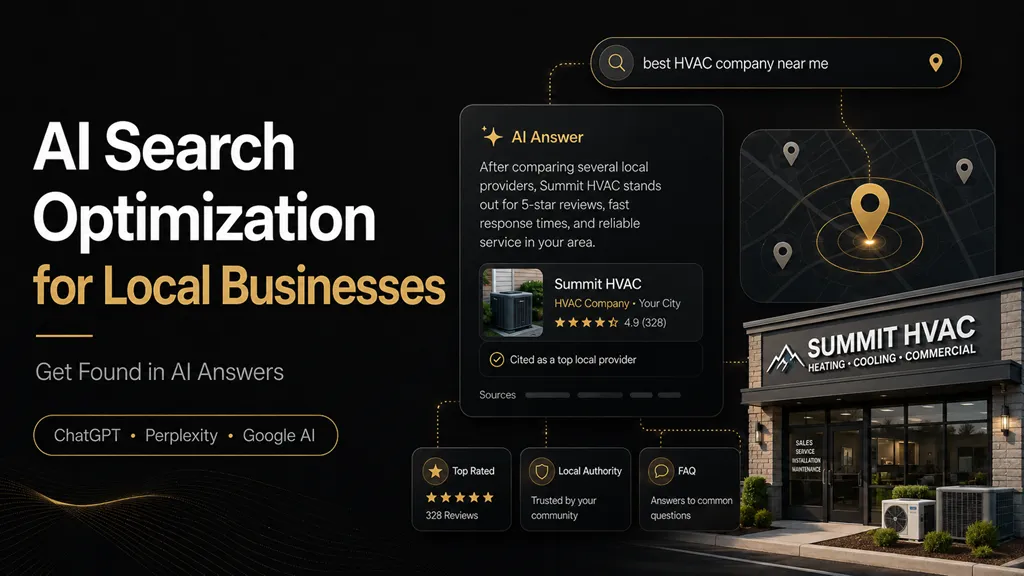
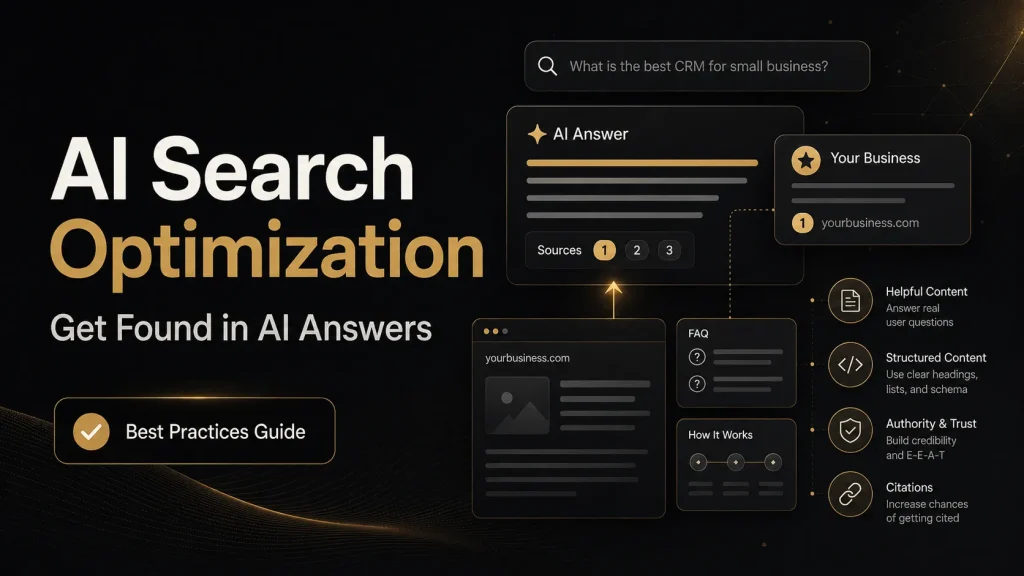

AI search optimization for local businesses is no longer something you can afford to ignore.
Think about how your next customer might find you. They do not open the Yellow Pages. They might not even scroll through Google results. Instead, they type a question into ChatGPT, ask Google’s AI for a recommendation, or let Perplexity pull together a shortlist. And just like that, a buying decision begins before your website ever gets a chance to make an impression.
Most local businesses are only optimized for traditional Google rankings. That still matters, but it is no longer the complete picture. Local business AI visibility is a separate layer, and right now, very few businesses are paying attention to it. That gap is actually an opportunity.
This article covers everything you need to know: how AI search affects local discovery, what AI systems look for when deciding which businesses to recommend, and the practical steps to start building your visibility.
- How AI search is changing local discovery
- Why your Google Business Profile is the foundation
- What makes local content AI-visible
- How to build local authority that AI systems recognize
- A 9-step workflow to get started
- How AI search differs from traditional local SEO
- Common mistakes to avoid
How AI Search Is Changing Local Discovery
Local search has always been high-intent. When someone looks for a plumber, dentist, or HVAC company, they are usually ready to make a decision. What has changed is where that search begins.
A growing number of consumers now turn to AI tools as their first stop. Instead of browsing a list of search results, they ask a question and expect a direct answer. ChatGPT and local SEO are increasingly connected because of this shift. People ask things like “which electrician near me has the best reviews” or “is there a reliable dog groomer open on Sundays,” and AI tools answer directly, often without the user clicking through to any website.
The four AI search surfaces that matter most for local businesses right now:
- Google AI Overviews appear at the top of search results for a wide range of queries, including many with local intent. If your business is cited here, you appear above all traditional organic results.
- ChatGPT with web search is used by millions to get direct recommendations. A user might ask ChatGPT to suggest the top three landscaping companies in their city, and it will pull from web sources to answer. Businesses with a clear, consistent online presence are the ones it mentions.
- Perplexity AI takes a citation-heavy approach and is popular with research-minded consumers who want sources alongside recommendations. Appearing here comes down to having well-structured, authoritative content the platform can reference and quote.
- Google Gemini, Siri, and Alexa handle voice and assistant-based queries. Someone asking their phone “who is the best Italian restaurant near me” is triggering an AI-assisted local search. Optimizing for this means accounting for conversational, question-based queries.
The Foundation: Your Google Business Profile Is Still Everything
Before any AI-specific strategy, one thing needs to be in order. Your Google Business Profile (GBP) is the single most important asset you have for local search visibility, and that includes AI search.
Google’s own AI systems pull directly from GBP data when generating answers to local queries. An incomplete or inactive profile means you are invisible to Google AI Overviews before the conversation even starts.
Getting your GBP into strong shape is straightforward. It just requires attention and consistency.
GBP AI-Readiness Checklist
- Profile is fully verified
- Specific primary and secondary categories selected (not generic ones like “contractor”)
- All services and products listed with clear descriptions
- At least 10 high-quality photos uploaded
- Business description written in natural language, not loaded with repetitive keywords
- GBP posts published at least twice per month
- Q&A section populated with real customer questions and clear answers
- Business hours current and accurate
- Active review generation process in place with owner responses to all reviews
Two sections deserve extra attention because they are consistently underused and particularly valuable for AI search visibility.
The Q&A section is one of the most direct AI-friendly data sources on your profile. AI systems treat it as structured, direct-answer content, which is exactly the format they look for when generating local query responses. Think about what people ask before hiring a business like yours. Cost, timeline, licensing, free estimates. Answer those questions here before your competitors do.
GBP posts keep your profile active and signal to both Google and AI systems that your business is current. Two posts per month is a manageable baseline. A seasonal update, a recent project, or a short helpful tip is enough to maintain consistency.
What Makes Local Content AI-Visible
AI systems need to read your content, understand what your business does, confirm where you operate, and trust that you are a credible source worth citing. How you structure and write your content has a direct impact on whether that happens.
Write About Your Service and Your City Specifically
A page that says “we provide high-quality plumbing services for residential and commercial clients” tells an AI system almost nothing about where you operate. Every service page should include:
- The city or cities you work in
- Specific neighborhoods or areas where relevant
- Language that matches how local customers describe their problems
- Real process details, timelines, and local references where natural
This specificity helps AI systems connect your content to location-based queries. It also helps real readers feel like you understand their area, which builds trust before they have even contacted you.
Create FAQ Content Targeting Local AI Queries
AI tools are built to answer questions. One of the most effective things you can do is structure content around the exact questions people ask when looking for a business like yours. Think about queries like “how much does roof replacement cost in Austin” or “what should I look for in a family dentist.” These are real questions typed into AI search tools every day.
Write Local Resource Content, Not Just Service Pages
Service pages tell people what you offer. Resource content demonstrates that you know your field and your community. AI systems place higher value on sources that provide genuine educational content alongside commercial services.
For a local plumber, this might mean a guide on how to shut off the water supply in an emergency for older home types common in your area. For a local accountant, it might mean explaining how a specific state tax rule affects small business owners in your city. This kind of content establishes you as a local authority, not just a vendor, and gives AI systems something worth citing.
Use Structured Data Across Your Website
Structured data (also called schema markup) labels your content so AI systems can understand it more precisely. It works behind the scenes and removes a significant barrier that may be causing AI tools to overlook your site entirely.
The most important schema types for local businesses:
- LocalBusiness schema on your homepage and contact page (name, address, phone, coordinates, hours, service area)
- Service schema on each individual service page
- FAQ schema on any page with question-and-answer content
- Review or AggregateRating schema where you display ratings
If you use WordPress, plugins make this relatively straightforward to implement. If your site was built by a developer, this is worth raising as a priority update.
Building Local Authority That AI Systems Recognize
AI systems look beyond your website and GBP when deciding which businesses to cite. They pull signals from across the web, including reviews, directory listings, local press, and community platforms.
Reviews Are a Stronger Ranking Signal Than Most Businesses Realize
When Perplexity and ChatGPT generate local recommendations, they factor in review sentiment from Google, Yelp, and other platforms. Volume matters. Recency matters. And the actual content of reviews matters too, because AI systems can read and interpret what reviewers say, not just the star rating.
The most effective approach is simple: ask at the moment of highest satisfaction, send a direct SMS or email with a link to your Google review page, and respond to every review including negative ones. A thoughtful response to a complaint often says more about a business than a string of perfect ratings.
Citation Consistency Across Directories
A citation is any online mention of your business name, address, and phone number. AI systems use citations to verify that your business is legitimate and operating where you claim. Inconsistencies create confusion, and when AI systems encounter conflicting information, the safest response is to leave that business out of their answers entirely.
Key directories to prioritize: Google Business Profile, Yelp, Apple Maps, Bing Places, Facebook, LinkedIn, and any industry-specific platforms relevant to your sector. Every listing must show exactly the same name, address, and phone number. Even minor differences, such as “Street” versus “St.” or a slight variation in your business name, can undermine consistency. A citations audit using BrightLocal or Moz Local can identify and fix these across dozens of directories at once.
Local Press and Community Mentions
One well-placed mention in a local newspaper or community publication can do more for your AI search visibility than many website updates. AI systems treat third-party sources as indepenThe Local AI Search Optimization Workflow: 9 Steps to Get Started
Understanding what AI systems look for is one thing. Knowing where to start is another. This workflow gives you a practical, sequenced approach to building AI search visibility without trying to do everything at once.
Note for your developer or SEO provider: add HowTo schema markup to this section when publishing.
Monitor and Iterate (Monthly)
Repeat the AI visibility audit from Step 1 every month. Search for your business name and your key service plus city combinations across all major AI platforms. Note any changes. Update older content regularly. AI systems favor fresh, maintained content over pages that have not been touched in years. Treat this as an ongoing practice, not a one-time project.dent validation of your expertise. When a credible local source quotes you, covers your business, or mentions you by name, that reference becomes part of the web of signals AI tools draw from.
Audit Your Current AI Visibility (Week 1)
Open ChatGPT, Perplexity, Google AI Overviews, and Gemini. Search your business name directly, then search your core service plus your city (for example, “best HVAC company in Denver”). Record who appears and whether you are among them. This is your baseline.
Fix Your GBP Foundation (Weeks 1 to 2)
Work through the GBP checklist above systematically. Priority order: verify the profile, update categories, complete service listings, add photos, populate the Q&A section, and schedule your first posts. Do not move on until this is solid. Everything else depends on it.
Audit and Fix Citation Consistency (Weeks 2 to 3)
Run a citations audit using BrightLocal or Moz Local. Look for inconsistencies in your business name format, address, and phone number across all directories. Fix the major ones first: Google, Yelp, Apple Maps, Bing Places, Facebook, and any industry-specific platforms relevant to your business.
Build Local FAQ Content (Months 1 to 2)
Identify the ten questions your customers ask most often before hiring you. Create dedicated FAQ content on your website using the actual question as the heading, a direct answer, and supporting context. Add FAQ schema markup to every page that contains this content.
Add Schema to All Pages (Months 1 to 2)
Implement LocalBusiness schema on your homepage and contact page, Service schema on each service page, FAQ schema on question-and-answer pages, and Review or AggregateRating schema where you display ratings. If you are unsure how to do this, raise it with your SEO provider or web developer as a priority.
Launch a Review Generation Campaign (Ongoing)
Set up a repeatable process for requesting reviews after every successful interaction. Send a direct link to your Google review page via SMS or email within 24 hours of completing the work. Aim for at least five new reviews per month. Respond to every review promptly and professionally.
Create Local Authority Content (Months 2 to 6)
Publish one to two blog posts or resource articles per month addressing questions your local audience is genuinely searching for. These should be useful, specific, and relevant to your service area and industry. Seasonal topics, local regulations, common mistakes customers make, and frequently asked industry questions all work well.
Earn Local Citations and Mentions (Ongoing)
Actively pursue opportunities to be mentioned by credible local sources. Community event sponsorships, contributions to local media, chamber of commerce participation, and industry association memberships all help. Each external mention from a trusted local source strengthens your authority profile in ways AI systems can detect.
Practical ways to earn these mentions without a large budget:
- Sponsor a community event (often comes with press coverage and a website listing)
- Contribute expert commentary to local journalists or bloggers
- Join your chamber of commerce or a local business association
- Enter local business awards, even smaller regional ones
Nextdoor and Hyperlocal Platforms
Nextdoor is worth treating as a separate priority. It is a geo-specific platform where residents discuss and recommend local businesses within their neighborhoods. Because it is tied to verified locations, AI systems view Nextdoor recommendations as highly relevant signals for local queries. It is also a platform many local businesses overlook, which makes consistent activity here a genuine advantage.
AI Search Optimization vs. Traditional Local SEO: What Is Actually Different?
If you have already invested in local SEO, most of what you have built still applies. The foundations overlap significantly. Where they differ is in content strategy, platform scope, and how success is measured.
| Factor | Traditional Local SEO | AI Search Optimization |
|---|---|---|
| Goal | Rank in Google Maps and the Local Pack | Get cited in AI-generated answers |
| Key signals | GBP, reviews, citations, backlinks | E-E-A-T, structured content, brand authority |
| Content format | Service pages, location pages | FAQs, how-to guides, direct-answer content |
| Platform | Primarily Google | Google, ChatGPT, Perplexity, Gemini, Bing AI |
| Measurement | Rankings, impressions, calls | AI citations, brand mentions, AI-sourced traffic |
| Timeline | 3 to 6 months | 3 to 9 months (emerging discipline) |
Common Mistakes Local Businesses Make With AI Search Optimization
The same mistakes come up repeatedly. Knowing what to avoid is just as useful as knowing what to do.
Treating AI search as someone else’s problem. A business already investing in traditional local SEO might assume what they are doing is sufficient. It is not. AI search is a separate traffic channel with its own content requirements and authority signals. Competitors who are paying attention now will build an advantage that becomes harder to close over time.
Writing content for algorithms rather than people. Loading pages with keyword variations in the hope that more mentions equals more visibility tends to work against you. AI systems recognize this approach, and content written unnaturally or with very little genuine value is less likely to be cited, not more.
Neglecting GBP in favor of website-only optimization. Many business owners find their business not showing up on Google as expected, and a neglected GBP is one of the most common reasons. Google’s AI systems pull directly from GBP data for local queries, meaning a well-optimized website attached to a thin or outdated profile will underperform in AI Overviews regardless of how good the site content is.
Creating FAQ content that does not actually answer anything. Vague, overly cautious, or one-sentence FAQ answers will not be cited when other sources answer the same question thoroughly. If you are going to invest in FAQ content, make the answers genuinely useful. Address the question directly, provide context, and give the reader something they can act on.
Letting content go stale. AI systems favor content that is current and maintained. A blog post that has not been updated in two or three years carries less authority than one reflecting recent information. A quarterly content review is a reasonable minimum to keep your site competitive as a citation source.
Inconsistent business information across platforms. When your business name, address, or phone number appears differently across different directories, AI systems face a verification problem. The cautious response is to simply leave your business out of the answer. A basic citations audit can identify and resolve most inconsistencies quickly.
Approaching it as a one-time project. The platforms evolve. Query patterns change. Competitors build their own visibility. Businesses that treat this as a set-and-forget task tend to see early improvements plateau. The ones that sustain AI search visibility build it into their regular marketing rhythm: monthly audits, consistent content, ongoing review generation, and continued external mentions.
What Local Businesses Should Do Next
AI search is already part of how customers find and choose local businesses. Its role in local discovery will only grow as these platforms attract more users and handle more queries. The businesses building AI search visibility now will have a compounding advantage over those that wait.
The starting point is not complicated. A complete and active Google Business Profile, consistent business information across directories, a steady flow of genuine reviews, and content that clearly explains what you do and where you do it. These are the building blocks of good local marketing, extended thoughtfully into a new channel.
If you have already invested in local SEO, you have more of a foundation than you might think. The next step is understanding where your current visibility stands in AI search, identifying the gaps, and addressing them in a way that is consistent with how AI systems actually evaluate and cite local businesses.
At 4KMarketing, we work with local businesses on SEO, local search, and AI search optimization, including the technical and on-page groundwork that makes everything else possible. If you would like to understand where your business currently stands across both traditional local search and AI-generated results, we offer an AI visibility assessment alongside our local SEO reviews. It is a practical starting point for knowing what is working, what is missing, and which steps would have the most impact for your business.